

This is the Chapter's Agent Orange Web Page
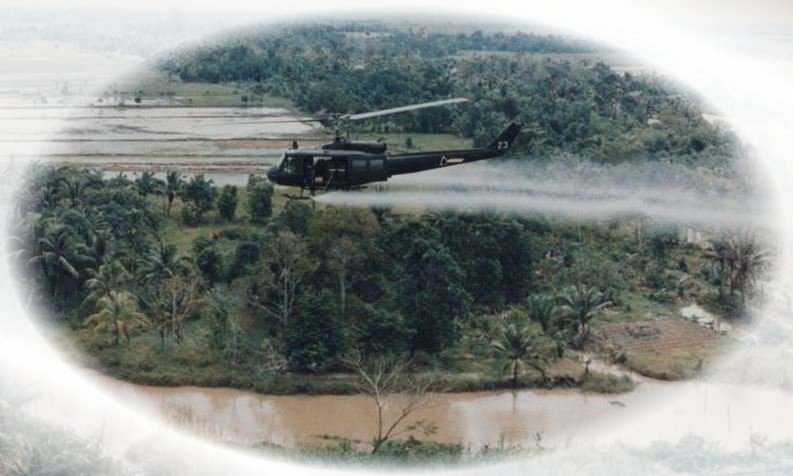
U.S. Army Helicopter Spraying Agent Orange Over Vietnam

Welcome to the Agent Orange Web Page for
Vietnam Veterans of America
Battlefield Chapter 617 and their Associates!
This page has a collection of information and web links about Agent Orange.
Agent Orange/Dioxin
Agent Orange is a highly toxic herbicide used
by the U.S. military during the
Vietnam War to defoliate hiding
places used bythe enemy and to clear the
perimeters of
military installations.
Although colorless, it is known as “Agent
Orange” because
of an
orange-colored band painted on the drums used
to store and transport
it.

In May 2021, VA
started implementing provisions of the William M. Thornberry National
Defense Authorization Act for Fiscal Year 2021 (NDAA), adding Bladder
Cancer, Hypothyroidism and Parkinsonism to the list of medical
conditions presumptively associated with exposure to Agent Orange.
A few months later VA added Asthma, Rhinitis and Sinusitis (to include Rhinosinusitis) on a presumptive basis based on particulate matter exposures during military service in Southwest Asia and certain other areas.
Please note, the new list of medical conditions listed above may not appear in the book or pamphlets below.

This Vietnam Veterans of America (VVA) guide is simple: to present information and
describe the process in a user-friendly fashion for a Vietnam veteran or (surviving) family member
to file a claim for service-connected disability compensation or death benefits with the Department of
Veterans Affairs (VA) for illnesses/diseases associated with exposure to Agent Orange and other related
herbicides during military service. At the outset, please understand that the VA claims process is
complicated, frustrating, and can be time-consuming. Please understand also that these guidelines
are not legal advice.
Veterans Exposed to Herbicides (Agent Orange)
Presumptive service connection is available
to veterans who served
in Vietnam
and parts of Korea along the DMZ.
The presumptive diseases are types
of Cancer with no time requirements for manifestation
and types of Soft Tissue Sarcoma with no time requirements for
manifestation.
Diseases other than Cancer with no time
requirement for
manifestation
Type 2 Diabetes (Also known as Diabetes Mellitus).
Diseases other
than Cancer with various
time
requirements, Periperal neuropathy
(acute or subacute), Chloracne, Porphyria Cutanea Tarda.
Also disabilities in children of Vietnam Veterans as Spina Bifida.






© American Cancer Society, Inc
"In studies comparing Vietnam veterans with
veterans who had served at the same time elsewhere,
TCDD (dioxin) levels were found to be higher
among those who had served in Vietnam,
although these levels went down
slowly over time.
Exposure to Agent Orange varied a great deal. Exposures
could have occurred in,
breathing the chemicals, ingesting them in through
contaminated food or drink, or absorbing
them
through the skin. Other exposure pathways may have
been possible as well,
such as through
the eyes or through breaks in the skin."
READ and LEARN MORE AT THE FOLLOWING WEB SITE:
https://www.cancer.org/Cancer/CancerCauses/OtherCarcinogens/IntheWorkplace/agent-orange-and-cancer
Wikipedia
A collaborations of articles and reference from Wikipedia about Agent Orange
https://en.wikipedia.org/wiki/Agent_Orange
Last Time Page Was
Updated - May, 2023
For comments and suggestions concerning
this web site, contact:
"Never again will one generation of veterans abandon another."